Biometrik Abteilung
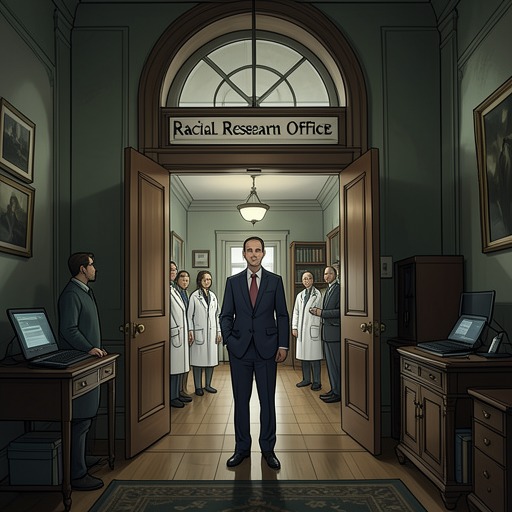
The Glass RoomBiometrik Abteilung is the Nazi biometric department established in the confiscated Landauer House, where a modernist domestic interior is turned into a system for examining, photographing, classifying, and recording human beings. Its procedures promise the cool precision of science, but the department’s purpose is racial governance; its eventual closure exposes the gap between what the measurements can establish and what Nazi ideology insists must be true.
Establishment in the Confiscated House
The department announces itself first through material occupation. Lorries bring chairs, shelving, desks, and filing cabinets; a wooden guard hut goes up inside the gate, and a metal sign bearing a wreathed Hakenkreuz names the Rasse- und Siedlungshauptamt, Forschungsstätte für Biologie, and Biometrik Abteilung. Neighbours watch through lace curtains. Children gather at a barricade before being chased away. The two houses across the road are requisitioned as well, one becoming a staff hostel. A week later, a dozen young scientific staff arrive and cross from the hostel into the Landauer House.
The department’s transformation reorganizes the house room by room. Upstairs rooms become offices, the kitchens are converted into a laboratory, and a basement room is prepared for an X-ray machine. The former darkroom remains available for photography. Curtains partition the Glass Room, turning its open interior into controlled work areas. In front of the onyx wall stand scales, a height-measuring stadiometer, and a chair fitted with steel rulers; callipers lie ready on tables. Drapes and lights make the dining area a photographic studio, with a Rolleiflex on its tripod. The Bösendorfer piano remains, incongruous amid the new instruments, its tones restored by a Jewish piano tuner.
The garage undergoes a different conversion. Deutsche Hollerith Maschinen Gesellschaft mbH equipment is unloaded there: large black machines of steel and Bakelite, including one that resembles a mangle and another, with a typewriter keyboard, as large as an upright piano. The former car space takes on the appearance of a newspaper print shop, complete with the hum of machinery and smell of ink and ozone. Soldiers carry in files gathered in Vienna. The house is no longer simply a place in which people live; rooms, equipment, and documents are assembled into an apparatus for turning bodies into data.
Examination and Classification
The subjects arrive by bus, in groups of no more than a dozen, divided by sex and approximate age. Soldiers at the gate watch as visitors are politely directed to the front door; the staff speak Czech or German as required. The measured manner is part of the department’s self-presentation. Its director, Stahl, instructs the staff to behave as scientists and to treat human subjects with the respect zoologists show animals. The reassurance does not alter the power imbalance: the people arriving have been brought into a state-run institution whose classifications may shape how they are treated.
A receptionist takes each subject down to the Glass Room, where a form records date and place of birth, languages, religion, race, and nation. It also asks about illnesses and conditions in the family ancestry, including mongolism, alcoholism, criminality, and mental retardation. The information is called confidential and is presented as an undertaking in pure science. Subjects then complete tests matching shapes, continuing sequences, and identifying patterns. They change into medical gowns, give blood through a needle prick, and have their blood pressure measured.
The bodily measurements are equally standardized. Staff work in pairs, one recording and one examining. The subject is positioned against the stadiometer with heels, buttocks, and shoulder blades touching the backboard, while the head is held in place and the chin set horizontal. The examiner adjusts the body until the pose is exact. Height, hip diameter, and chest diameter are recorded; then come measurements of the arms and legs, followed by the head dimensions taken in a chair whose callipers hold the skull in place. Skin colour is compared with a von Luschan chart, and eye colour with rows of model eyes. The procedure is described to the subjects as painless and routine. Stahl watches as each stage turns the person in front of the examiner into measurements on a record.
Photography and mechanical processing extend the examination beyond the room. The subjects are asked to remove their gowns for photographs, while the staff reiterate that this is a scientific examination and that the records are confidential. In the garage, Hollerith machines are intended to sort, assemble, and analyse the accumulated information. Punched cards are duplicated and sent from the department to Prague, then on to Berlin, where the machines can sort them at a rate of one hundred and fifty cards per minute. The promise is that patterns and correlations will disclose the keys to race and identity. The scale and speed of the system lend its conclusions an air of authority, though speed and precision cannot make its racial categories valid.
Scientific Method and Political Purpose
The department’s work depends on a division between observation and interpretation that the institution cannot sustain. Its forms, measurements, photographs, files, and punched cards present classification as a technical process: collect standardized data, identify correlations, and derive racial diagnoses. In practice, the categories have been decided in advance. The machinery is asked to confirm racial distinctions demanded by the regime, while people are made to supply the data through which those distinctions will supposedly be proved.
That contradiction becomes explicit when Reinhard Heydrich visits. The centre has been thrown into a panic by uncertainty about the itinerary, until an official schedule fixes the inspection for eleven in the morning, with the staff assembled. During the visit, Heydrich asks whether inherited diseases can identify Jews. Stahl explains that not all Jews have those diseases and that people with such diseases are not necessarily Jewish. The laboratory, he says, is pursuing another approach: measuring minute variations of phenotype and searching for combinations that might produce a racial diagnosis, with the Hollerith machines to sort the data.
The exchange lays bare the limits of the project. The researchers can report measurements and correlations, but their own explanation acknowledges that these do not yield the clean racial boundary the political authority wants. The department’s procedures may be exact in the narrow sense of repeatable measurement; that precision does not establish that its categories are natural, consistent, or capable of identifying a person’s racial identity. Its performance of objectivity is thus not separate from ideology but enlisted in its service.
The figures entering the department’s returns reinforce this tension. For April, Stahl reviews 672 assessments: 316 classified as Slav, 239 as Aryan, and 112 as Mischlinge of varying degrees, with Roma and Jews recorded separately in an addendum. He quickly loses interest in the totals and requests the file for Hana Hanáková. Meanwhile, the punched cards continue onward to Prague and Berlin. The juxtaposition is telling: people appear as totals and classifications in the monthly report, while the administrative system also preserves individual files that can draw the attention of those operating it. The archive is not an abstract collection; it is a mechanism that brings named persons within reach of institutional scrutiny.
Individuals Within the Archive
The department’s paperwork intersects with personal desire and vulnerability. Stahl requests Hana Hanáková’s file and waits for it while completing the returns. Her name arrives on a buff folder bearing the department’s official insignia. The scene links the broad machinery of racial classification to the individual dossier: a form and a file do not merely store information but make a particular person administratively legible and accessible to the official who asks to see her records.
Elsewhere, the institution’s governing categories meet the lives they would reduce to data. At the inspection, Stahl describes the attempt to diagnose race through phenotype even as he acknowledges that no single inherited disease maps neatly onto Jewish identity. Hana, in a separate confrontation with Stahl, tells him that her husband is Jewish. Her statement brings the regime’s classification into the intimate space of the Glass Room and challenges the distance between the department’s abstract language and the people whose identities it seeks to sort. The department’s promise to observe neutrally cannot insulate its work from the coercive political world in which those labels carry consequences.
The appearance of refugees in the Glass Room offers another sharp contrast to the institution’s orderly procedures. A family of four and a woman with her daughter are brought before an audience; the children and their mothers are examined by the room’s onlookers as if they were part of a staged display. The single mother is Kata, whose precarious circumstances include taking money from Viktor when she could not find work, pay rent, or provide clothes for her baby. This is not a biometric examination scene, but it reveals how the same room’s formal rationality can coexist with the exposure of vulnerable people to other people’s judgment. The department’s glass and carefully proportioned space do not guarantee ethical clarity; they can make visibility itself a form of pressure.
Closure and Afterlife
The decisive test of the department’s scientific standing comes from the authority that created the conditions for its work. The Reichsprotektor’s office orders the Biometric Centre closed and its personnel returned to their previous occupations. A call to head office in Berlin confirms the reason: Heydrich does not consider the research justified. If it cannot scientifically distinguish Nordic, Slav, and Semitic populations, the work must be flawed. The governing assumption is not reconsidered. Instead, the supposed failure lies in the scientists’ inability to quantify what the regime treats as obvious common sense.
Closure dismantles the centre without undoing the larger apparatus it has served. Personnel pack their suitcases and receive rail passes to Berlin, Jena, and Leipzig. Measuring instruments and furniture are removed; files are boxed for transfer to Berlin, while furnishings are sent to offices in Město, Prague, and Warsaw. The Hollerith machines are unscrewed from the garage floor and loaded onto trucks for an undertaking judged more fruitful: the new camp complex being established in Silesia near Oświęcim. The department’s research has failed by its own stated standard, yet its equipment and records are redistributed rather than simply abandoned.
The history of Biometrik Abteilung therefore turns on a bitter distinction between the failure of a research claim and the continued usefulness of its administrative tools. The Centre cannot supply the clear racial diagnosis its superiors demand, but the forms, files, measurement routines, and punched-card technology remain available to the institutions of Nazi rule. In the Landauer House, the Glass Room’s carefully balanced proportions become the setting for a project that mistakes classification for knowledge and precision for truth. Its dissolution exposes that mistake while showing that an institution can close even as the machinery it built moves on.